Number Partitioning Example
The Number Partitioning problem divides a set of integers into two subsets such that the difference of their sums is minimized. It is NP-hard and has applications in task scheduling and fair division.
import getpass
import os

from dotenv import load_dotenv
from luna_quantum.algorithms import SCIP

from luna_usecases.number_partitioning import (
    NumberPartitioningCollection,
    NumberPartitioningData,
    NumberPartitioningFormulation,
    NumberPartitioningInstance,
)

load_dotenv()
if "LUNA_API_KEY" not in os.environ:
    os.environ["LUNA_API_KEY"] = getpass.getpass("Enter your Luna API key: ")
Create Data
Define 7 integers to partition into two subsets with equal (or closest) sums.
data = NumberPartitioningData.from_values(numbers=[7, 5, 3, 2, 8, 4, 1])
data = NumberPartitioningData.generate_random(8)
print(data.to_string())
Plot Data
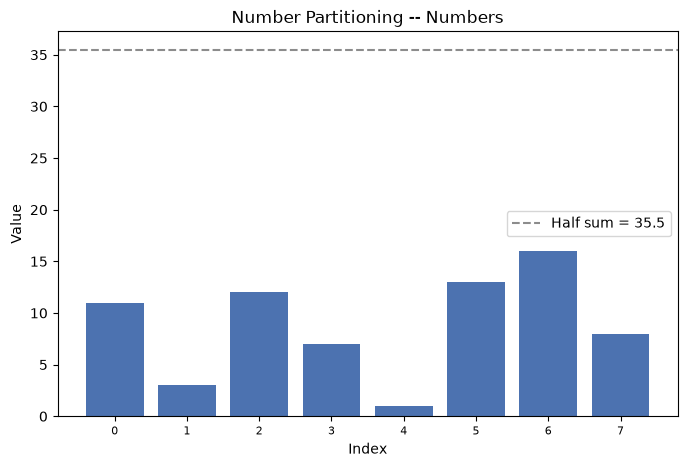
Visualize the number distribution.
Create Formulation
Minimize the difference between the two subset sums.
Number Partitioning Formulation:
  Numbers: 8
  Total sum S: 71

Decision Variables:
  x[i] in {0,1} for i = 0, ..., 7
  x[i] = 1 if number i is in partition 1
  Total: 8 binary variables

Objective:
  minimize (2 * sum_i n[i] * x[i] - S)^2  where S = 71
  Expanded: sum_{{i,j}} n[i] * n[j] * x[i] * x[j] - S * sum_i n[i] * x[i]

Constraints:
  None (unconstrained binary optimization)
Create Instance
Combine data and formulation into a solvable instance.
instance = NumberPartitioningInstance(data=data, formulation=formulation)
print(instance.to_string())
Data:Number Partitioning Problem:
  Numbers: [11  3 12  7  1 13 16  8]
  Total sum: 71
  Number count: 8
Formulation:Number Partitioning Formulation:
  Numbers: 8
  Total sum S: 71

Decision Variables:
  x[i] in {0,1} for i = 0, ..., 7
  x[i] = 1 if number i is in partition 1
  Total: 8 binary variables

Objective:
  minimize (2 * sum_i n[i] * x[i] - S)^2  where S = 71
  Expanded: sum_{{i,j}} n[i] * n[j] * x[i] * x[j] - S * sum_i n[i] * x[i]

Constraints:
  None (unconstrained binary optimization)
Formulate Model
Translate the instance into a mathematical optimization model.
Solve and Interpret
Solve the model with SCIP and interpret the raw result into a use-case-specific solution.
scip = SCIP()
job = scip.run(model)
sol = job.result()
uc_solution = instance.interpret(sol)
print(uc_solution.to_string())
/Users/maximilianjanetschek/PycharmProjects/luna-usecases/.venv/lib/python3.13/site-packages/rich/live.py:260:
UserWarning: install "ipywidgets" for Jupyter support
  warnings.warn('install "ipywidgets" for Jupyter support')
Number Partitioning Solution:
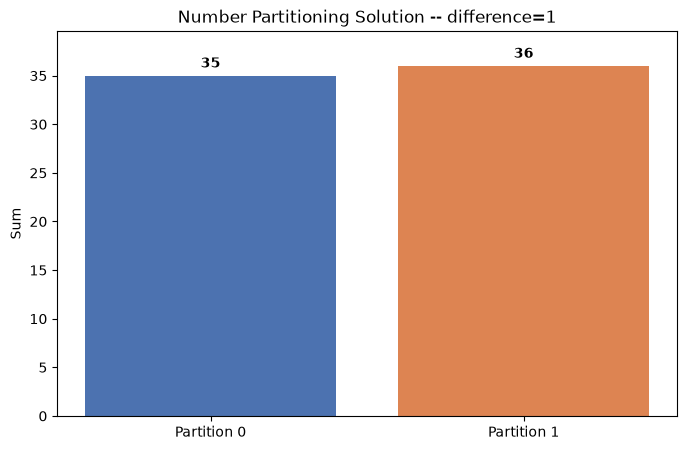
  Partition 0: [11, 3, 12, 1, 8] (sum=35)
  Partition 1: [7, 13, 16] (sum=36)
  Difference: 1
  Valid (perfect partition): False
Plot Solution
Visualize the optimal solution.
Collections
Generate a benchmark collection of random instances for batch processing.